Part II, Barnsdall-Rio Grande Service Station
On the History Highway with Curt CraggBefore we stop for lunch at the restaurant next to the station, a little history on the Barnsdall-Rio Grande Company and their discovery of oil on the shores of Ellwood Beach.

There was no doubt that oil existed off of the shores of Santa Barbara. It had been discovered in Summerland just to the south in 1894 triggering a dramatic boom in population and speculation in this seaside town. In fact, “Seaside” was one of the brand names adopted for the company behind this succesful oil speculation.
It was Kate Den Bell, the daughter of Nicolas A. Den, a grantee of the Dos Pueblos Rancho, that predicted that oil would be found on the Ellwood shores in 1920. Kate would not allow her prediction to be explored during her lifetime, but after her death in 1928 a geologist named Frank Morgan convinced his employer, the Rio Grande Oil Co. to obtain exploration rights from Kate Bell’s heirs.
Seeking a partner for this wildcatting operation, the Rio Grande Company combined with the Barnsdall Oil Co. to explore this unproven location. They began drilling on June 1, 1928. They had agreed to drill to 3,000 feet at a cost of about $10.00 a foot and if the well didn’t prove out at that depth to give up. At 3,160 feet, the drilling supervisor asked for permission to pull the plug. As a last ditch effort before giving up they asked the geologist Morgan to have one last look at the final coring. Morgan detected traces of petroleum.
They drove the bit ten more feet and struck a gas pocket, at just over 3,200 feet they found the oil. It was a gusher generating 180 barrels per hour.
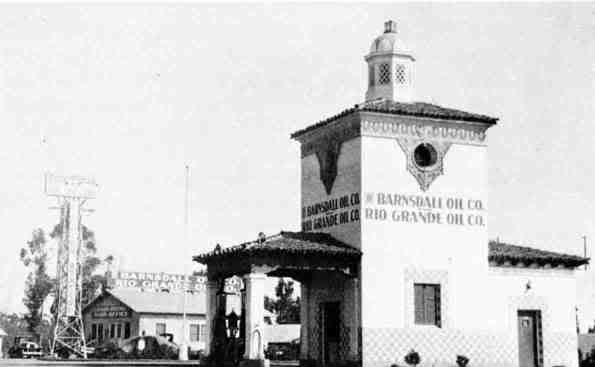 Note the headquarters building just past the station.
The petroleum was so prolific that the company did not have the capacity to refine all of it as it was produced. While the storage and delivery facilities were being built Barnsdall and Rio Grande made arrangements with Seaside Oil Company to take all of the surplus flow.
The speculators behind the Barnsdall and Rio Grande Oil Companies were rich, paying $650,000.00 in taxes on their first year strike alone. Although the cost and design of the small flagship station seemed extravagant, the expense was nearly insignificant relative to the earnings of the rich oil reserve behind it along the shores of Ellwood in Santa Barbara County.
Don’t leave, we haven’t eaten yet. The story of the restaurant next to the service station is coming soon…[This message has been edited by the poor mans museum (edited 04-08-2006).]


